Title: A Study in Scarlet
Author(s) Name(s): Sir Arthur Conan Doyle
Published in: I887
Why You Might Like This Book: Read this book if you enjoy
- classic thrillers,
- heavy suspense,
- brilliant detectives,
- unexpected twists,
- revenge, and
- classic British fiction.
Who Should Avoid This Book: Avoid this book if you are triggered by or dislike
- violence, murder, and torture,
- religious extremism,
- sexual violence, or
- grief and loss.
This is the first novel in a series of four stand-alone Sherlock Holmes novels. This novel has two parts with seven chapters each and the story is narrated through Watson’s perspective, as observations made by him. Dr Watson is a British man, trained in medical sciences, who worked abroad as an assistant surgeon, beside the army officers, in war zones. When he got severely wounded and his health began deteriorating, he was forced to come back to his home country, and he chose to live in London.
The Introduction of Sherlock Holmes – The World’s Best Fictional Detective:
Sherlock Holmes is to crime fiction what Albert Einstein is to physics. It is not possible to be a fan of crime fiction thrillers and investigative, detective stories and not have heard of the sassy, confident, quick-witted “Sherlock Holmes”.
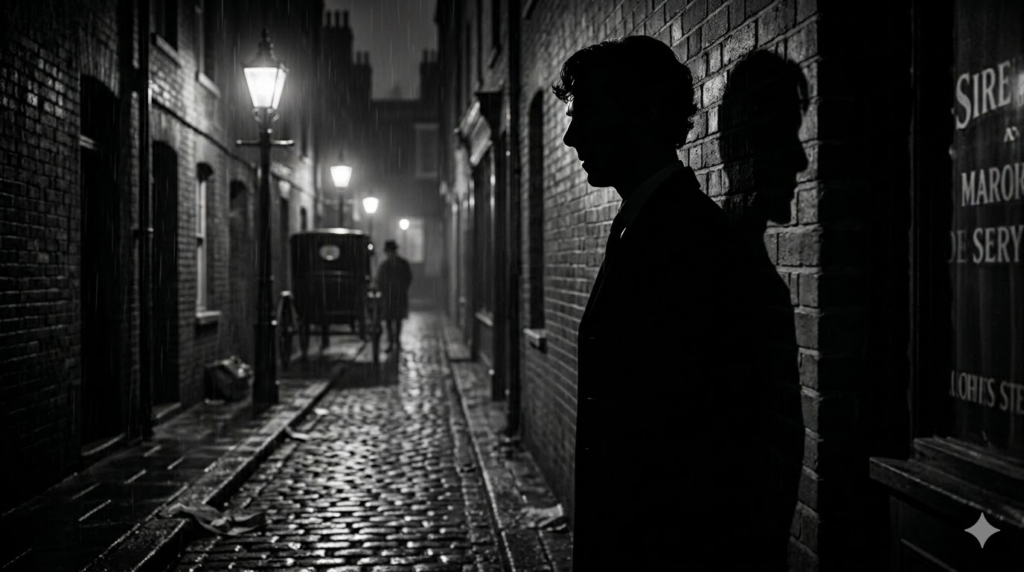
The retired doctor had no family, so he had to live alone, soon, it became financially difficult, and around the same time, through a friend, he came to know that another British man, a young, shrewd guy in London was looking for a roommate, so that he could split the expenses with the mate. That is how Dr Watson came to know about Sherlock Holmes – a tall, thin, weird, eccentric, definitely smart man, who could play the violin, box, and even fight well. When the two met for the first time to discuss about sharing a house, Holmes immediately commented that Watson must have served in Afghanistan; that was a very accurate guess, which surprised Watson because how could he have possibly known? Holmes showed a lot of interest and was highly knowledgeable in certain areas like the history of crime, chemistry, and such, and was almost totally ignorant and uninterested in other areas like astronomy, politics, and such. Holmes would often have strangers visiting him, and what his housemate did for a living Dr Watson did not know, but one day Holmes himself opened up and told Watson that he works as a “consulting detective”, meaning that professional detectives, both those working for the government and the private investigators, who could not solve their cases would come to Holmes, and stated very confidently that he has some very unique skills that let him make remarkable observations and brilliant deductions, so combining this with his knowledge of crime, he would be able to solve all those cases for them.
Dr Watson struggles with accepting what his friend says so confidently about his science of observation and deduction even though he sees his friend making accurate comments about people around them easily, so when Sherlock Holmes receives a letter from Detective Tobias Gregson informing him of a crime, a murder that has happened in London, requesting him to come there, study the scene and the body, then help the detective solve the crime, Watson agrees to join Holmes.
Spoilers ahead!
The Scotland Yard detectives, Lestrade and Gregson, are not intelligent enough, according to Sherlock Holmes, to do their jobs as detectives. And this one appears to be one of the most mysterious incidents they all have seen. An American man named Enoch Drebber was found dead in an empty hosue in Brixton. A wedding ring is found when they examine the crime scene and the body has no wounds. There is the word “rache” written on a wall with blood. Holmes explains to them that that is the German word for “revenge”. He is convinced that the victim was poisoned. Holmes begins asking questions and investigating. He asks the police officer, John Rance, who first found the body to explain what had happened. The officer explains that when he was walking past the house, he saw that there was light inside the house, which is usually empty, so it didn’t make sense, and when he went inside to check, he saw the dead body, and there was also a drunken man nearby whom he asked to leave. Holmes is certain that the “drunken man” is actually the murderer, who came back to the scene of crime to take back the ring.
Holmes places an ad that the ring was found, using the ring as bait to catch the murderer. Watson and Holmes eagerly await the person, but they are surprised when an old woman comes to collect the ring, stating thst it is her daughter’s wedding ring. They collect her address and contact details, give her the ring, and let her go, but Holmes decides to follow her, hoping to catch the criminal, inisisting that the old lady must be an accomplice. But after following her a long way, Holmes finally realises that he lost her, and concludes that the “old woman” was a man in disguise, who also knew that he was being followed. The address the person gave was also fake, it was someone else’s address. News about this very odd crime scene spreads across town, and the newspapers state that this must be a political crime committed by the socialists and that their country is too liberal to let outsiders in so freely. This story involves a criminal who is just as smart and skilled as the highly intelligent detective himself is, so that only makes the story more interesting!
The next day, Lestrade and Gregson follow their own hunches and each takes a different path to try and find the killer. Holmes explains to Watson that he doesn’t trust the two cops to find anything because cheating them is far too easy, so he takes the help of some poor Arabs there who can go everywhere, notice everything, and collect the information he needs for him. Gregson comes to visit Holmes and proudly explains that he found out who the killer is and even had him, Arthur Charpentier, arrested, giving Holmes and Watson a lengthy explanation. Just as he finishes his narration, Lestrade arrives with some bad news, telling them that he had a hunch that the victim’s assistant, Stangerson, also an American must somehow be involved, so he made many calls to identify the where he was staying temporarily, then when he reached there, he found that Stangerson was also murdered. There was blood, a deep wound on his chest, Drebber’s wallet, an old telegram, and a bottle of pills. At this point, when everyone is upset that not only could they not catch the murderer but he also has killed another person, Holmes surprises everyone, including Dr Watson, declaring that he has found out who the murderer is. Everyone else is shocked and demand an explanation. Holmes starts with telling them and also proving to them that the pills Lestrade found there near the body of Stangerson’s body were poisonous pills. Almost immediately after this, the local Arabs come back to tell him that they have a cab waiting for him downstairs. The rest of them start to lose their patience with Holmes and his sassiness because he told them to wait until he could do his job himself and catch the killer because the killer is shrewd and he wouldn’t want to alert the killer. Holmes hints to them that they should be ready to catch the killer. He asks one of those Arabs to go down and bring the driver up to help him carry some of his luggage down for him, and when the driver arrives, Holmes smartly, quickly, and carefully handcuffs the driver and tells the rest of them that this man, Jefferson Hope is the killer. The driver/murderer tries to escape but all four of them fight and struggle, ultimately capturing the criminal. Part 1 of the novel ends here. Everyone, the constables, Dr Watson, and the reader are left wondering how Holmes deduced the identity of the killer, what was the motivation behind the crime, and all other such things.
The reader’s curiousity would only naturally peak with such an ending to part 1, where a person nobody suspected, everyone else thought of as a normal, ordinary person in the neighbourhood was the killer but there are no reasons or explanations given yet, and all those questions will be answered in part 2. For readers who find part 1 interetsing, part 2 would only be twice as interesting. It’s completely unexpected for a couple of murders that happen in London to be connected to events and an entire community in North America. There is a long flashback that runs to decades before the present about how a helpless man and a young girl are lost in the middle of nowhere, with no source of water or food anywhere nearby, starving for a few days at least, until they are found and rescued by a group of immigrants – the Mormons. In return for them to be rescused, the old man and his daughter – he adopts the girl child in that moment – should become Mormons themselves and remain true to the religion and abide by the laws of the Church of the Mormons for the rest of their lives. This part reveals to us a very cruel, dark side of Mormonism in the nineteenth century in Utah. And how could the detective connect the dots in a case so complicated, which he calls “simple”? That’s what makes Sherlock Holmes the best fictional detective to date.
While almost everyone who can speak English would have heard of the name “Sherlock Holmes”, not enough credit is given to the brilliant author Sir Arthur Conan Doyle. While there are dozens of popular detective stories today, most of them are either directly or indirectly inspired by the character Sherlock Holmes. The writing is gripping, no word feels like unnecessary page-filling, and the book manages to keep the reader thoroughly engrossed. “A Study in Scarlet” is a must-read, this is a classic, and I’d definitely give it a 5-star rating. Anyone interested in crime fiction must read this at least once.
Interesting Quote: “I consider that a man’s brain originally is like a little empty attic, and you have to stock it with such furniture as you choose. A fool takes in all the lumber of every sort that he comes across, so that the knowledge which might be useful to him gets crowded out, or at best is jumbled up with a lot of other things, so that he has a difficulty in laying his hands upon it. Now the skillful workman is very careful indeed as to what he takes into his brain-attic. He will have nothing but the tools which may help him in doing his work, but of these he has a large assortment, and all in the most perfect order.”