Title: A Brief History of Time
Author(s) Name(s): Stephen Hawking
Published in: September, 1988
Why You Might Like This Book: Read this book if you enjoy
- physics,
- scientific theories about the universe,
- learning about subatomic particles,
- space, time, and black holes, and
- unanswered questions in science.
Who Should Avoid This Book: Avoid this book if you are triggered by or dislike
- NA (not applicable).
Recommended for children? Yes!
In this book, Hawking covers highly complicated concepts in physics such as the theory of relativity, wave-particle duality in quantum physics, and many more such highly scientific theories in simple terms, so that most readers would be able to understand at least the essence of these. You get the feeling that this is a book that was written with the main goal of taking complicated subjects in physics and making it intellectually easy to access and understand for the average adult. Yes, this is Hawking’s attempt to take science to the general population, for those who are not professionals or academics in the field of physics. This book definitely makes the average reader curious. The onus is then on the reader to try to assess their own understanding and curiousity following this read.
Another thing that makes this book lovely is that it is mostly self-contained. Yes, to understand scientific terms, one might need to check a dictionary or the Internet for the meaning. But for those with basic knowledge of science, to understand and enjoy the contents of this book, they don’t need to have any prerequisites.
For almost every paragraph in this book, I had to pause and read a few times, and some, more than a few times. Honestly, this only made the book more interesting. In fact, I had put this book aside a few times because at certain points , it got too complicated for my understanding, leaving me confused, so I had to come back and start from where I had left the last time. And now that I have read this, I would not only recommend this book for every science enthusiast out there, for every adult and child who is even remotely interested in science, but also wish that I had the possibility of meeting the author/scientist/astrophysicist genius at least once in person, and sadly, he is no more.
—
The first chapter of this book gives us a timeline of intellectual pursuits by scientists, starting from those in the ancient world to the modern-day world, all of whom asked and attempted to find answers about the universe, how they all attempted to ignore religious fairytales, for which they were met with criticisms, and so on. Hubble’s observations of remote galaxies and how they continuously move farther away from us tell us that the universe is ever-expanding. This would mean that there would have existed a point in time when all the objects in the universe where densely packed together. The reader already starts understanding how scientists make inferences from data!
Hawking also tells us what a scientific theory is in simple words and what makes a theory a good theory: it must accurately describe a large class of observations on the basis of a model that contains only a few arbitrary elements, and it must make definite predictions about the results of future observations. One excellent example for a “good scientific theory” would be Newton’s theory that objects attract each other with a force that’s proportional to their mass and inversely proportional to the square of the distance between them.
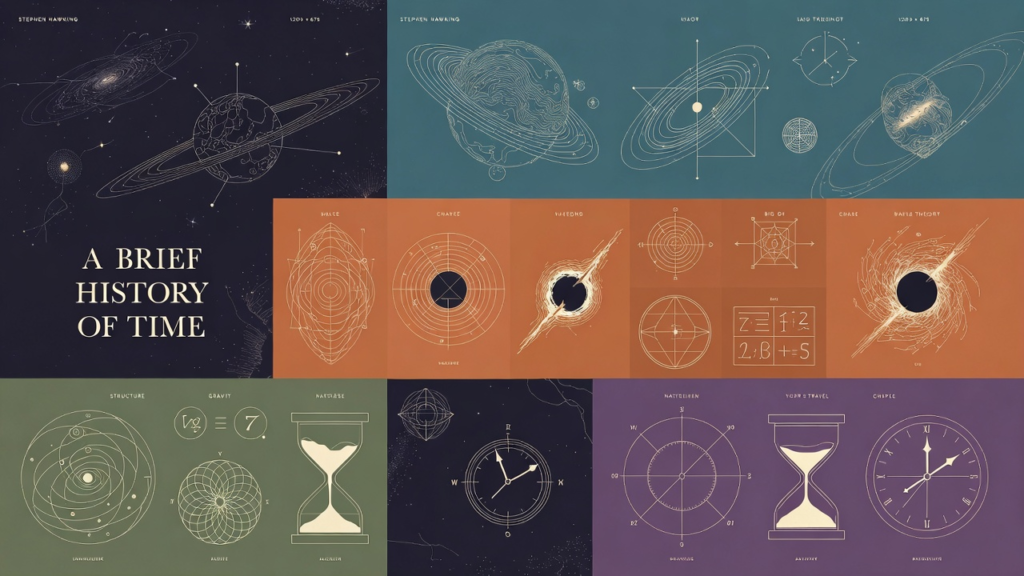
He goes on to explain that a theory will always remain a hypothesis, one that’s just in our heads, and no matter how many observations are noted, you can never be absolutely sure that it will apply for the next observation, but on the other hand, a theory can be disproven. He also explains how most of the scientists use two different theories, one is the general theory of relativity and the other is quantum mechanics. The former explains the events around the large-scale structure of the universe and the latter explains the events of the universe in a much smaller scale, and unfortunately, these two theories don’t agree with each other, both can’t be right at once. Could we arrive at a theory that unifies both – a quantum theory of gravity? This is a deeply passionate pursuit for lots of physicists even today, and many believe that we have come closer to finding the answer, but nobody is sure that they have provably cracked it yet.
(The part where the author brings up multiple valid questions about this one, grand unified theory, and if such a theory, a valid one governing everything in the universe already exists, then doesn’t that decide when and how we’ll arrive at that theory itself or we may not and never do it reminded me of the funny “neurobiology vs. physics” debate scene between Amy Fowler and Sheldon Cooper in American sitcom The Big Bang Theory!)
—
The second chapter begins with simple explanations of Newton’s laws of motion, and we learn how Newton’s theories showed that there is no such thing as “absolute rest” for a body, even though Newton himself refused to accept it, as a believer of God. We are then told about Clark Maxwell’s findings and how mankind learns that light waves travel at a fixed speed, but fixed speed related to what – the “ether”, a concept they came up with (which Einstein would later tell us is unnecessary to understand the universe). The experiments carried out by Albert Michelson and Edward Morley showed that irrespective of the direction or the motion of earth, the speed of light was always the same. There are mentions but not with many details of Hendrik Lorentz and Henri Poincaré.
At this point, the author explains Einstein’s famous equation, E = mc^2, the one which connects an object’s energy with its mass and the speed of light, showing us how, as the speed of an object increases, its mass increases and it would take more and more energy to speed it up, which is why no object can travel faster than light does because at the speed of light, the body’s mass would be infinite and it would require infinite energy to reach there. Only light or other waves that have no intrinsic mass can move at the speed of light! Another interesting result of The Theory of Relativity by Einstein is that it shows us that given that the speed of light is a constant and different observers on different positions would disagree or see different distances light has travelled, it could mean only one thing, that they all have to disagree on the time taken for light to travel that distance, too, which meant that time must be relative as well, not absolute, going against Newton’s theory. It is concluded that time by itself cannot be separated from or be independent of space, so we must accept a combined object called “space-time”. But we as humans can’t visualise of portray 4 dimensions, 3 of them showing the distance in 3 different dimensions, such as the latitude, longitude, and height about the sea level, and the fourth being the time dimension in “space-time”.
While these are some of the basics, which the author has explained really well, in the upcoming chapters, there are many more interesting and more complicated concepts. From the subatomic particles to cosmology, there are chapters on the properties of quantum objects, like spin and uncertainty, and the origin of the universe, The Big Bang Theory, and black holes. This book is a fantastic physics book and a must-read for anyone who is interested in either science or the history of the universe or the future. Owning a copy of this book could feel like having access to several important books in physics and cosmology. This is what great scientists do: they are driven by curiousity, share their findings, are open to criticisms and healthy debates, and never stop learning. The world misses you and some of your like-minded mentors and peers, Stephen Hawking!
Note that it is totally normal to struggle with understanding science at such levels, so you might want to put it away when you feel frustrated or excited, it is understandable if you struggle to absorb these complicated concepts, but don’t give up on the book yet: keep reading until you understand and you will be happy and thankful that you did! For explaining deeply scientific concepts in layman’s language, for keeping the reader continuously interested and curious, for elevating the reader’s knowledge about the universe, I would give this a 5-star rating. This book must be one that all students get to read in school. Physics and astronomy can be hard to understand but not impossible to understand.