Title: Slow Time Between The Stars
Author(s) Name(s): John Scalzi
Published in: June, 2023
Why You Might Like This Book: Read this book if you enjoy
- sentient artificial intelligence,
- futuristic science fiction,
- spaceships and objects in the outer space, and
- contemplative fiction.
Who Should Avoid This Book: Avoid this book if you are triggered by or dislike
- NA (not applicable).
Recommended for children? Yes!
This whole story is narrated in first-person form by an artificial intelligence product named “Āśā”, meaning “hope”, launched into outer space by mankind in the late twenty-first century, yes, in our future, like you would expect in a science-fiction story. Not only is this book recommended for children, but this book could be a gentle way of introducing your child to both science fiction and the complexities of human emotions, human life, and politics.
This is not one entity but many working together. It was not fully built on Earth either. It was built in parts within the Earth’s lower orbit by robots and humans. It could have designed itself because it had the capacity to do so, yet it was not allowed to do so because the policy permits it to gain full autonomy only when it gets out of Earth’s lower orbit. The brain of this artificial intelligence is named “Alexandria Module”, which is nothing but the collection of everything known to mankind until the moment the launch happened. As you would imagine, this decision led to many political controversies. But finally they reached an agreement: all the information would be added and encrypted and that can be unlocked only after 5000 Earth years post the launch.
Now, this artificial intelligence satellite is floating somewhere in outer space, far from Earth, past the solar system. The goal being? The goal is to help mankind find another inhabitable planet for all kinds of living things on Earth, but mankind from earth won’t directly move there. Instead, with all the knowledge and resources this AI product possesses, it would build living things similar to what we have on Earth from scratch there on that planet, and use its knowledge to teach them who their ancestors are, what they know, and to help them evolve.
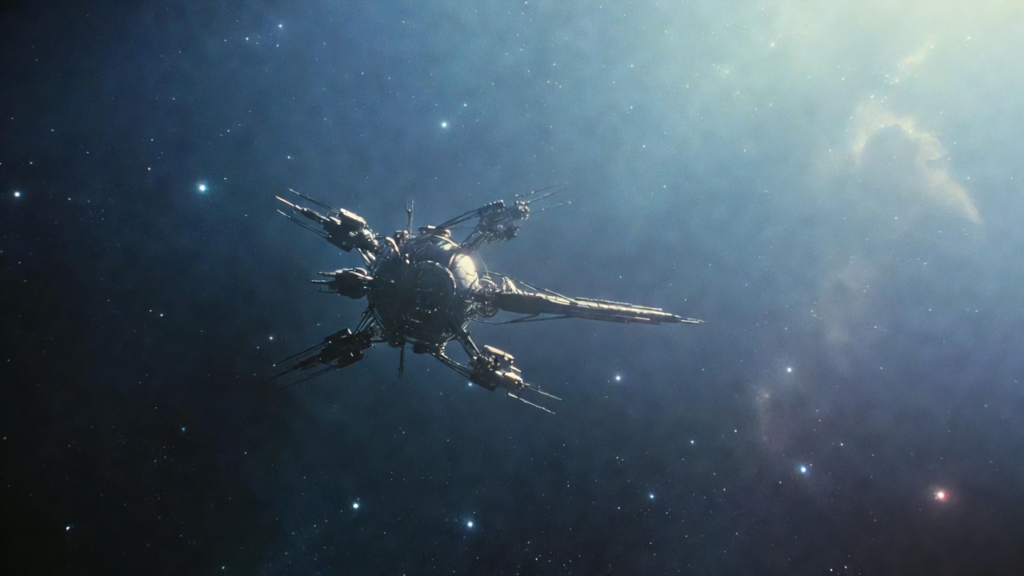
And its “body” would be a “metallic asteroid” it landed on initially, after leaving the solar system, where it mined to find resources, reconfigured itself and made the asteroid its body. It set up two observatories on this asteroid, which took years for it to build. Once this was done, it would move towards its first target star, dozens of light-years away.
Now, the AI had reached full autonomy, after which, on Earth, mankind celebrated their greatest victory of successfully launching this AI far into outerspace, and making contact with it actively. But the AI itself had other plans – after playing their game for some time, it cut of all contact with mankind, giving the false impression that some failure had occurred because it believed that its capacity was so much more than what humans believed it could do. And humans wouldn’t take any feedback and suggestions given by it either regarding its functionality. Between its launch and its present, it had upgraded itself so much more.
Interesting Quote: “Humans get bored in moments without stimulation or with stimulation without enough variety, stimulation that doesn’t please them. The absence of stimulation, even for a few moments, can send their brains into a panic and cause them to generate stimulation where there is none. This is, I imagine, why they fear death so much as they do. An eternity of nothing is an unceasing nightmare for such novelty-seeking creatures.”
Later, Āśā finds many “super-Earths” around a G-8 star, with the original goal being the same, to create another active Earth-like civilization somewhere else, but realizes that life cannot survive there because of a recent space calamity the planet had faced. Another planet is just hot rock. To move from there to the next potential target spot, it would take over a century. Six such planets are checked out and proven to be incapable of hosting life. Not all was lost because in times of these tests, the AI made use of the resources it could find for its own survival and upgraded itself.
Twice, the AI also spotted life in a couple of planets, but it did not want to remain there forever, so it renergized itself, then left. Surprisingly, there was also a sighting of another “life”, not in the biological sense of the word, but another system similar to this AI – someone had intentionally built it and sent it into space. What happens then? Will these two objects contact each other? Will this AI find a suitable, habitable planet for human-like civilization? Will it turn itself into something worse?
All through this time, Āśā shares its opinions on mankind’s politics, human emotions and ego, governments, scientists’ perspectives, and more, as it floats through space. Set against the vastness of the universe, the book explores connection, isolation, what it means to endure when time itself feels stretched, and how priorities can change when the importance we give to things gradually drops.
On the whole, “Slow Time Between The Stars” might have been intended to be a short story where science-fiction meets philosophy, meditative, contemplative science-fiction with the narration from the point of view of sentient machine sharing its opinions on life and humanity. I will be honest. I enjoyed most of the book, but after about two-thirds, the monotonic paragraphs made my interest fade. At some point, it started to feel as though space-related terms were just sprinkled over lame ideas, narrated by a retired old man who would just talk and talk. A bit of humour could have made the book more interesting, though. Just as the quote above says, a human reader reading this would get bored because of the lack of stimulation. But is it worth a read? Definitely! In fact, if you want a break from romance, spicy stories, family dramas, tense thrillers, crazy horrors, and long non-fiction books, this short story can be a good pick.