Title: Michelangelo
Author(s) Name(s): Diane Stanley
Published in: January, 2000
Why You Might Like This Book: Read this book if you enjoy
- art history,
- biographies and memoirs of famous professionals,
- historical non-fiction,
- art work,
- the renaissance period,
- European history,
- the personal lives of famous artists,
- photobooks,
- paintings,
- illustrations,
- classic art,
- mankind’s most popular works of art,
- Italian culture in the 15th and 16th centuries, and
- Greek and Roman art.
Who Should Avoid This Book: NA
Recommended for Children? Yes, for ages 8 and above.
Michelangelo is widely regarded as the greatest artist of all time. In this book authored by Diane Stanley, we get to see several beautiful paintings and learn about Michelangelo’s life, the later years of that period in European history, and his contributions to the field of art in different forms – paintings, sculptures, and architecture – during the Renaissance period.
Michelangelo’s family originally lived in Florence, Italy, which was the city where most of the stunning art work of that time period created by many different artists could be found. Theirs was a moderately wealthy family, but they were losing their social status along with their wealth, and the father Lodovico Buonarroti did not want to settle for jobs that were considered lowly for his status, so when he was offered a job he liked in Caprese, he rode to Caprese with his pregnant wife, their son, and their unborn son Michelangelo. The young boy who was then born in Caprese did not leave the city when the family moved back to Florence and was then raised by a stone cutter and his wife, a nurse. It was in this place that his skills of “stone-cutting” and sculpting began. He then went back to Florence but when he was just six years old, his mother passed away, then he had to live with stone cutters again. When he had first begun working as an apprentice to a sculptor, unlike others, he was already familiar with the art.
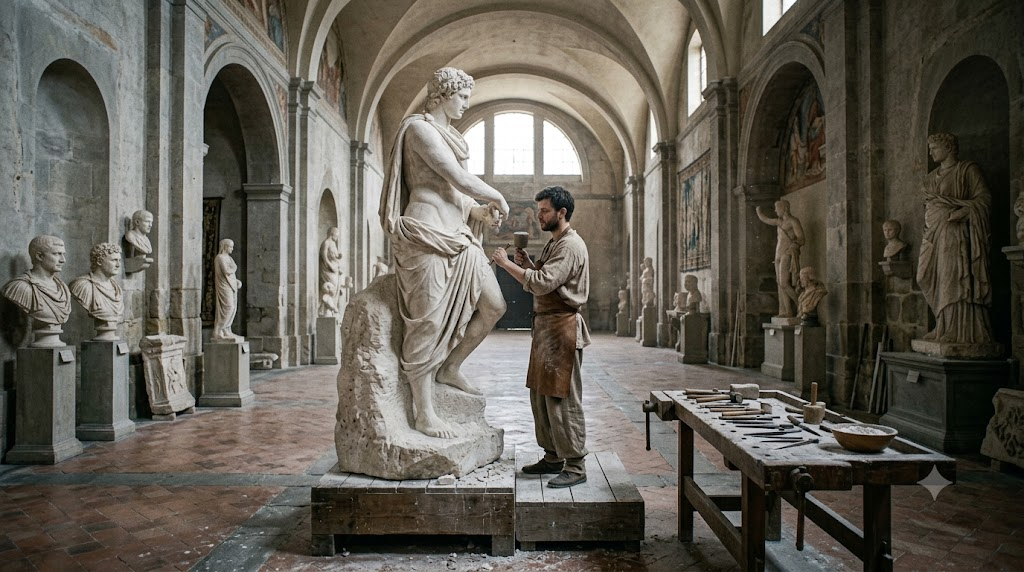
When his father had remarried and enrolled him in a grammar school, hoping that his lessons there would help him grow up to be a gentleman and find a worthy job, Michelangelo had no interest in any of that. The young boy was deeply absorbed in paintings and art, which his father considered a very poor professional choice. He got the opportunity to work as an apprentice, along with his friend Francesco and other apprentices, to Ghirlandaio, to help their master on a series of fresco paintings, which are quite difficult to do because the material would dry up soon. As luck would have it, within a year, he got the opportunity to present his art work to Lorenzo Medici, the richest man in all of Florence back then, a leader who deeply admired art. While working on a project commissioned by Lorenzo, Michelangelo taught himself the art of working with marble, making sculptures like the Greeks and Romans did.
He often preferred to work alone and alienated most of his friends and the people around him; once his words drove an angry young boy Torrigiano over the edge, so he punched Michelangelo hard, leaving his nose permanently disfigured. Lorenzo had come to realize how talented this young boy was, so he contacted the boy’s father and asked him to let his son come and live in the palace along with his otehr children, also offering the father a respectable job. Suddenly, his life changed – he was surrounded by the most brilliant people and grew up with the young Medici boys, two of whom later would become Popes and one of whom would take after Lorenzo as the ruler. But none of them would achieve the kind of fame and recognition that he would.
Later, Michelangelo had to work and earn for his family, after Lorenzo had died, so he created the sculpture of a nude Hercules. To study the human anatomy further, he went to a local hospital’s morgue and dissected bodies. He travelled from city to city, and Florence was no longer the city it used to be, thanks to the incapable and arrogant ruler, Lorenzo’s son and a religious extremist Savonarola. People of Florence were burning their beautiful and valuable possessions, the same things they once admired and loved, an event called “bonfires of the vanities”. Given that it was not the right place for artists then, he left Florence and moved to Rome, which is where he would create one of his masterpieces.
He was recruited by a French cardinal to make a marble sculpture of Virgin Mary holding a crucified Jesus in her arms, a sculpture called “Pietà”, meaning “pity”. It was this work that served as the beginning of his fame as an artist. He took two years to finish this sculpture, focusing on every minute detail possible, making it look perfect and real. It was the end of a century, the year 1500, and pilgrims and religious leaders and people who admired the arts visited Rome just to catch a sight of this extraordinarily beautiful work. And the artist was only twenty five years old then. Soon, he became very popular and patrons hired him to do enormous amounts of hard work, which left him exhausted.
In 1508, he was commissioned by the Pope himself to work on what would turn out to be yet another one of his masterpieces, but this time, it was a work of paintings, not sculptures – to pain all of the ceiling of the Sistine Chapel. In this case, though, he was not alone; he had several assistants working under him, but they were all let go and replaced at some point because Michelangelo was a strong critic of anyone, including himself, and he expected everyone to meet his standards, which was not easy at all. In 1502, this was shown to the public, but the artist was extremely stressed during this period because this job took a heavy toll on well-being.
As a critic and perfectionist, as someone from the working class who was exhausted, as someone who preferred to be a scupltor but was commissioned to do very demanding paintings, as someone who preferred to work alone than with others, throughout his life Michelangelo had difficult relationships with his patrons, colleagues, peers, and assistants. Even with other brilliant artists of his time, like Raphael and Leonardo Da Vinci, he had disagreements. Of the many Popes and religious leaders he worked with, some strongly criticized his work for the nudity across all his paintings and sculptures, deeming that to be cheap, but a majority of those who witnessed his work found all that to be marvellous. Despite all this, his love for art did not end; he went to contribute to great architectural projects and poetry as well. Until he grew old and died a natural death, his passion for art continued and he kept creating.
Michelangelo is a photobook filled with beautiful paintings and the narrative is a fairly easy read. This is a book that is suitable for young children and several parents and teachers acknowledge that the children they have read this book to enjoy this, mostly because of the paintings they get to see. Also, the story of Michelangelo would by itself be inspiring for kids. Adults would enjoy this as well given how this artist’s works leave people spellbound even today; such is the talent of this artist. I would give this book a 3.5-star rating. Grab one for your niece or nephew if you will or for a class of young children for their next reading session. Given that this book is intended for children and is a short biography with lots of paintings, it does not cover all the aspects of his life or all of his works or his wealth or other such areas. If this interests you, then you may want to read a more detailed version of the story of his life.